
How to Send Your Luggage Ahead in Japan (And Travel Hands-Free)
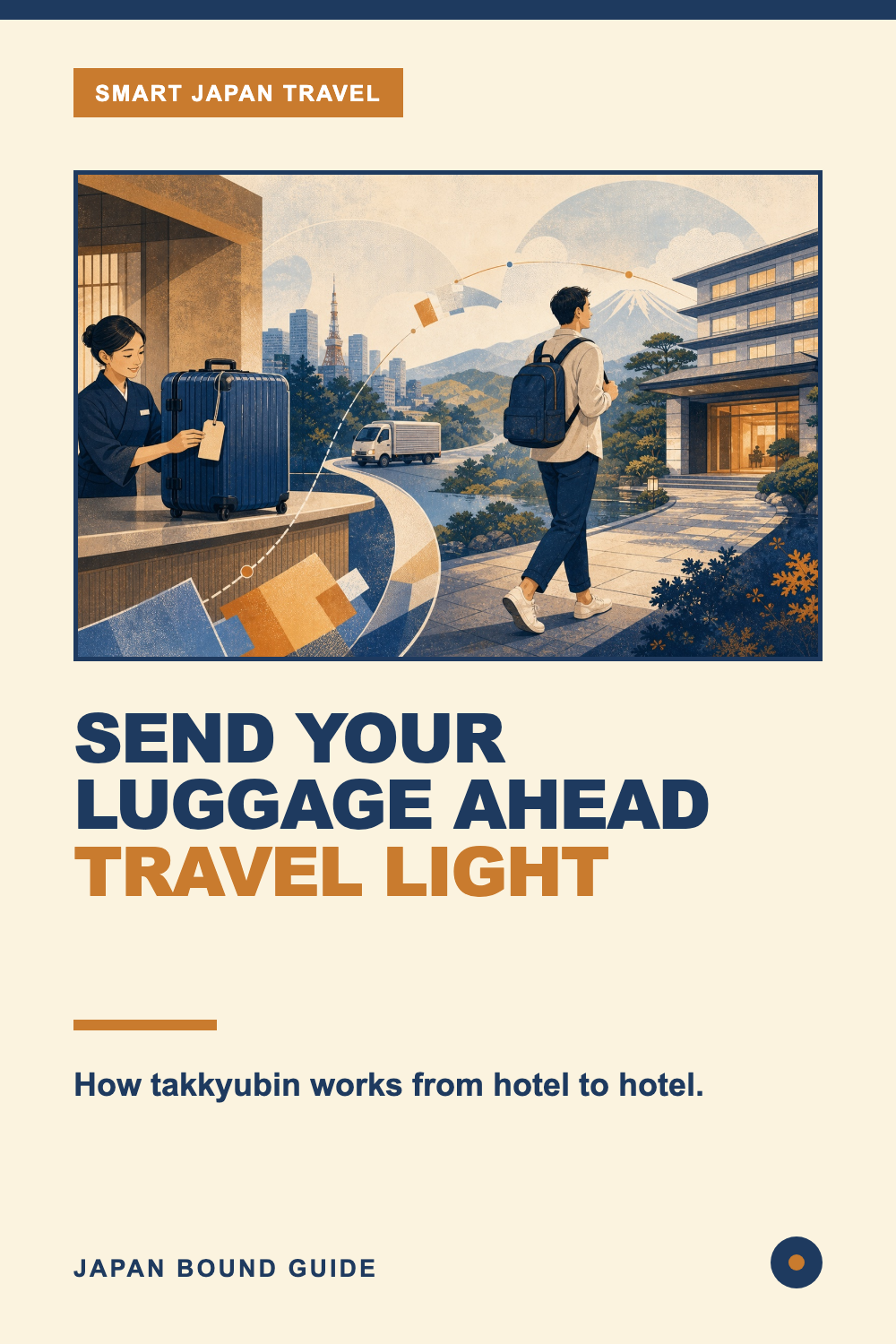
Japan’s train stations are efficient, but they’re also often crowded, full of stairs, and not especially forgiving if you’re hauling two suitcases through a transfer at rush hour. The common solution — and one the Japan Tourism Agency itself actively promotes — is sending your luggage ahead by courier instead of carrying it. It’s called “hands-free travel,” and it’s a genuinely normal thing for both tourists and locals to do here.
How it actually works
The main service most visitors use is Takkyubin — Yamato Transport’s parcel delivery service, officially branded TA-Q-BIN in English. The specific product for this is Airport TA-Q-BIN, which moves luggage between major Japanese airports and your hotel (or vice versa). You drop your bag off at a counter — at the airport, your hotel, or a participating convenience store — fill out a waybill, and Yamato delivers it to your specified destination, usually by the next day.
Sending from the airport to your hotel: drop your bag off at a Yamato counter after you land, and continue on to your first stop unencumbered while your suitcase catches up with you.
Sending from your hotel to the airport before you fly out: this is the one that requires planning ahead. You need to drop your bag off by the sending deadline — two days before your departure date in most areas, three days in some — and it’ll be delivered to the airport by the day before you fly, ready for pickup at a participating counter on the day itself.
What it costs
Airport TA-Q-BIN pricing depends on the distance between the two points, and runs from about ¥1,595 (cashless) or ¥1,600 (cash) at the low end up to roughly ¥5,126 (cashless) or ¥5,130 (cash) at the high end, per bag, one-way. That price already includes the ¥660 airport handling fee. There’s a weight limit — parcels over 30kg aren’t accepted — and very large bags (over a certain size) can’t be dropped off at some convenience store locations, so an airport or hotel counter is more reliable for oversized luggage.
If you’re sending a bag to the airport and know you’ll want to send one back the other direction later, Round Trip TA-Q-BIN gets you a ¥100 discount per bag on the return leg, and you can use that return trip any time within a month of your original drop-off.
Beyond the airport: station lockers and city-to-city shipping
Yamato also runs a broader “Hands-Free Travel” program in partnership with Japan’s Tourism Agency, which includes temporary baggage storage at station counters (with a particular concentration of service points around Osaka and Kyoto) and same-day delivery options, including same-day delivery specifically to Haneda Airport. The same basic courier network can also be used more generally — sending a suitcase from a hotel in one city to a hotel in the next stop on your itinerary — through the same kind of counter drop-off process, though the pricing for that kind of city-to-city shipment depends on your specific route.
For international travelers specifically
If you’re flying an ANA international route out of Narita, Haneda, or Kansai International Airport, there’s also a hands-free option that sends your luggage all the way through to your destination airport overseas — you don’t have to carry it through Japanese customs and check-in yourself. One notable exception: this isn’t available on routes to the United States, including Hawaii, due to U.S. Federal Aviation Administration restrictions.
Practical tips
Plan the sending deadline into your itinerary, especially for the hotel-to-airport direction — two or three days isn’t a lot of buffer if you decide the day before you fly that you’d rather not carry your bags. Convenience stores are a genuinely easy drop-off option for a normal-sized suitcase, and staff are used to handling these waybills for tourists. And if you’re only dealing with a couple of hours between checking out of a hotel and catching a train, a station locker or Yamato’s temporary storage counter is usually a better fit than trying to arrange next-day delivery.
Conclusion
Sending your luggage ahead isn’t a niche trick — it’s standard infrastructure in Japan, actively promoted by the tourism agency because it makes crowded stations and train transfers genuinely easier to deal with. Budget a couple of days of lead time for airport-bound shipments, expect to pay somewhere in the ¥1,600–¥5,100 range per bag depending on distance, and you can spend the rest of your trip without dragging a suitcase up a flight of station stairs.


コメント