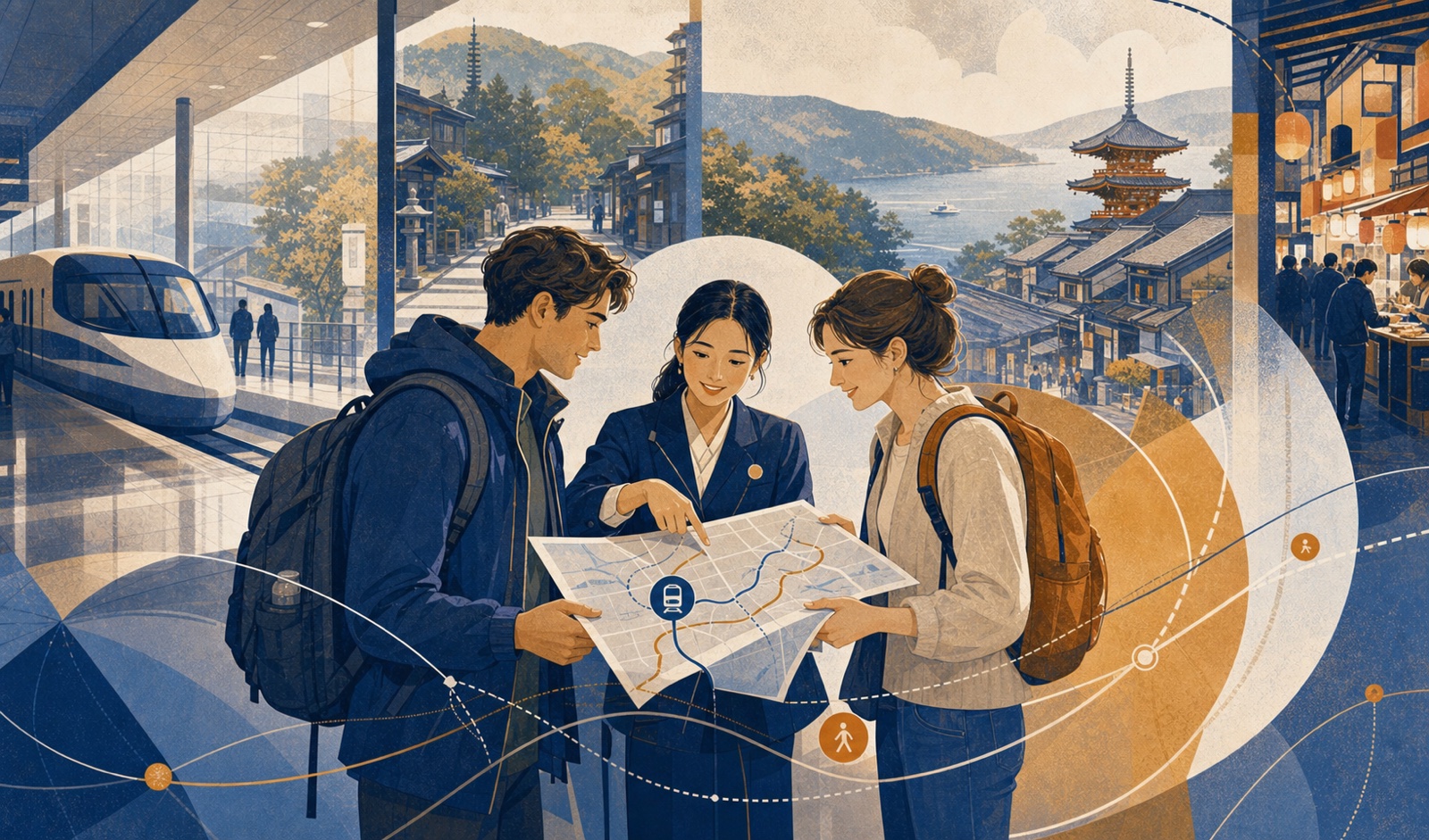
Best Guided Tours and Day Trips from Tokyo & Kyoto
Tokyo and Kyoto are both good enough bases to never leave, but some of Japan’s best sights are a short train ride away — a mountain shrine town, a feudal capital-turned-Buddhist-temple-city, a volcanic hot spring resort with a view of Fuji. The harder question isn’t where to go, it’s how: do you book a guided tour, or figure out the trains yourself? And once you’ve decided, which booking site do you actually use?
This guide covers both. First, the day trips themselves — what’s there, how to get there, and whether your Japan Rail Pass actually covers it, because for a couple of these, it doesn’t. Then, a straight comparison of the three biggest tour-booking platforms, so you’re not gambling on which one to trust with your money.
Day trips from Tokyo
Nikko. A mountain town a couple of hours north of Tokyo, built around the elaborately carved Toshogu Shrine — the mausoleum of the shogun who founded the Edo period. It’s a full day, easily, once you add the walk up to the shrine complex and (if you have time) Lake Chuzenji further into the mountains. One thing worth knowing before you book: the standard route to Nikko runs partly on Tobu Railway tracks, not JR. Specifically, the segment between Kurihashi and Tobu-Nikko requires a separate Tobu fare — your Japan Rail Pass covers you as far as Kurihashi and no further. If a guided tour or all-in-one train pass is priced to include that gap, it’s solving a real problem, not just upselling you.
Kamakura. The easiest of the four, and arguably the best for a half-day rather than a full one. It’s the old seat of Japan’s first shogunate, known today for its giant bronze Buddha and a cluster of temples you can walk between. The JR Yokosuka Line runs straight from Tokyo Station to Kamakura in well under an hour, and the whole route is JR track — no private-railway gaps to worry about here, so this is one of the few day trips where your Rail Pass genuinely covers the whole journey without an asterisk.
Hakone. The go-to hot spring escape, with the bonus of (weather permitting) postcard views of Mt. Fuji across Lake Ashi. This one is worth being precise about, because it trips people up: once you’re in the Hakone area, none of the local transport — the mountain railway, the cable car, the ropeway, the sightseeing boat — is JR. It’s all run by Odakyu, a separate private railway, and the standard way to get around is the Hakone Freepass (currently ¥7,100 for a 2-day adult pass from Shinjuku, covering eight different modes of transport in the area). Your JR Pass gets you nowhere in Hakone itself. This is exactly the kind of trip where a guided day tour — or at minimum, buying the regional pass in advance — saves you from piecing together four separate tickets on the day.
Mt. Fuji & the Fuji Five Lakes. If Fuji itself, not just a distant view of it, is the point, you’re heading to the Kawaguchiko area. Same story as Hakone: the direct train route (marketed as the “Fuji Excursion” limited express) runs on JR track only as far as Otsuki — the rest of the way to Kawaguchiko is Fujikyu Railway, a private line your JR Pass doesn’t touch. Between the transfer and the separate fare, this is another trip where a lot of visitors find a packaged tour genuinely less hassle than DIY-ing it.
Day trips from Kyoto
Nara. Japan’s earlier ancient capital, most famous now for a park full of deer that will eat right out of your hand, plus Todaiji Temple’s enormous bronze Buddha. The JR Nara Line’s rapid service connects Kyoto and Nara in around 45 minutes, and — unlike the Tokyo-area trips above — this route stays on JR track the whole way, so it’s fully covered by a Rail Pass.
Osaka. Less a “day trip” than a next-door city — Kyoto and Osaka sit on the same JR line, close enough that plenty of visitors base themselves in one and bounce back and forth. Osaka Castle, Dotonbori’s neon and street food, and Universal Studios Japan (if you’ve got kids, or just want the rollercoasters) are the usual draws.
Arashiyama & Fushimi Inari. Technically both still inside Kyoto city limits, but far enough from the historic center that they function like day trips. Arashiyama has the famous bamboo grove and a scenic riverside district; Fushimi Inari is the shrine with the thousands of vermilion torii gates climbing the mountain behind it — arguably Kyoto’s single most photographed spot. Both sit on JR lines running out of Kyoto Station.
When a guided tour actually beats doing it yourself
Not every one of these needs a tour guide. Kamakura, Nara, and the in-city Kyoto spots are straightforward enough on a map and a train app that plenty of independent travelers do them without a second thought.
Hakone and the Fuji Five Lakes are the two where a packaged tour earns its price more often: multiple transfers, a private railway your pass doesn’t cover, and (for Fuji specifically) weather that can make an independent trip a bust if you didn’t check the forecast. A guided tour bundles the transport, usually builds in the best viewing spots and timing, and — this matters more than people expect — gives you a fallback plan if the mountain’s covered in cloud that day.
Nikko sits in between: doable independently, but the Tobu Railway fare gap and the size of the shrine complex mean a lot of visitors are happier with a guide who already knows the route and can explain what they’re looking at.
Comparing the booking platforms: GetYourGuide, Viator, and Klook
Once you’ve decided you want to book a tour rather than DIY it, you’ll run into the same three names repeatedly: GetYourGuide, Viator, and Klook. All three are legitimate, widely used booking marketplaces — the real differences are in catalog focus and how their cancellation policies work.
| Platform | Cancellation policy | Notes |
|---|---|---|
| GetYourGuide | Most listings offer free cancellation up to 24 hours before the activity starts — but this varies by activity, so check the specific listing before booking | Broad catalog across Europe and Asia; strong presence for Japan day trips specifically |
| Viator | Markets “free cancellation” as a core feature; the default “Standard” policy is 24 hours before start, though “strict” listings require 7 days and some “all sales final” bookings can’t be cancelled at all | Owned by Tripadvisor, so listings are tied into Tripadvisor reviews |
| Klook | No platform-wide policy — cancellation terms are set per operator and per listing, and can range from “cancel anytime before pickup” to a fixed cutoff with fees after | Strong for Asia-specific products (originally Hong Kong-based), including regional transport passes like the Hakone Freepass |
The practical takeaway: don’t assume any of the three guarantees free cancellation platform-wide. Read the specific listing’s policy before you book, regardless of which site you’re on — Klook makes this explicit, but GetYourGuide and Viator both have exceptions too, they’re just less prominently flagged.
Beyond cancellation terms, the honest answer is that all three are worth checking for the same trip — prices and available time slots for the same tour operator can differ between platforms, and for something time-sensitive like a Mt. Fuji day tour, you want whichever one has the departure time and cancellation flexibility that actually fits your itinerary.
Recommendation by use case
If you want the widest selection to compare against: check GetYourGuide first — it tends to have deep coverage for Japan day trips specifically.
If you’re already relying on Tripadvisor reviews to vet tour operators: Viator’s integration with Tripadvisor makes that comparison easier in one place.
If you’re also buying a regional transport pass (like the Hakone Freepass) alongside your tour: Klook is also worth checking, since it covers transport products as well as guided tours.
For Hakone or the Fuji Five Lakes specifically: lean toward a guided option over DIY, given the private-railway transfers involved.
For Kamakura or Nara: you likely don’t need a tour at all — both are fully on JR track and simple enough to do independently, especially if you already have a Rail Pass.
Conclusion
The right call isn’t “always book a tour” or “always DIY it” — it’s matching the trip to the transport reality. Kamakura and Nara are simple enough to just show up and go. Hakone and Fuji involve a private railway your JR Pass won’t help with, which is exactly where a guided tour or a pre-bought regional pass earns its cost. Whichever platform you end up booking through, read the specific cancellation policy on that listing — it varies more than the marketing copy suggests.


コメント