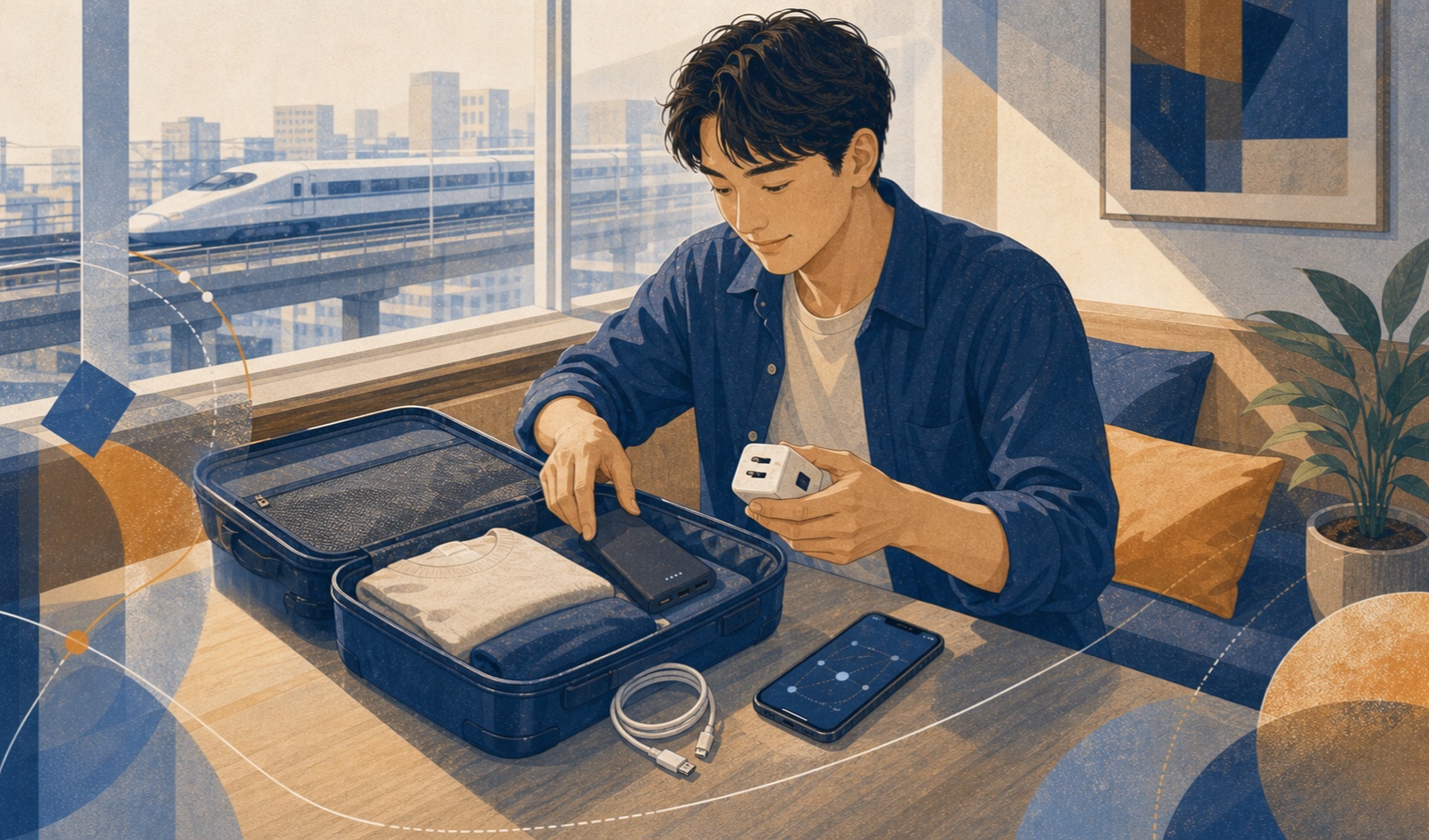
Most Japan packing lists cover the obvious stuff — comfortable shoes, layers for the weather, a portable charger. The things that actually trip people up are smaller and more specific: the wrong plug adapter, a suitcase that’s a few centimeters too big for the shinkansen’s storage rules, or realizing at the airport that you never sorted out how you’re getting online. Here’s what’s actually worth sorting out before you fly.
Power plugs and voltage
Japan runs on 100V AC nationwide, which is lower than the 120V standard in the US and noticeably lower than the 220–240V used across most of Europe, the UK, and Australia. The plug shape is the same two-flat-pin design used in North America, so US travelers often don’t need a shape adapter at all — just be aware of the voltage difference. Travelers from anywhere with round-pin or three-pin plugs (most of Europe, the UK, Australia) will need a physical adapter regardless.
Voltage matters more than shape for some devices. Dual-voltage electronics — most modern phone chargers, laptop chargers, and a lot of hair dryers and shavers — are built to handle a range of voltages automatically and will typically work fine in Japan without any conversion. Anything that isn’t dual-voltage (check the label — it’ll say something like “100-240V” if it is) needs an actual step-down transformer, not just a shape adapter, or you risk damaging the device. If you land without one, adapters and transformers are easy to find at electronics districts like Akihabara in Tokyo or Nipponbashi in Osaka, or at major chains like Yodobashi Camera and Bic Camera.
One more regional wrinkle: Japan’s electrical frequency isn’t uniform either. Eastern Japan (including Tokyo) runs on 50Hz, while western Japan (including Nagoya, Kyoto, and Osaka) runs on 60Hz. This matters far less than voltage for most modern electronics, but it’s part of why “just bring a universal adapter” isn’t quite the full story. If you’re relying on outlets during a long shinkansen ride, note that availability depends on the train set: older N700/N700A cars generally have outlets only at window seats and at the front/back of each car, while the newer N700S sets have one at every seat. There’s no way to request a particular outlet when you book — it comes down to which train and car you end up on — so it’s worth bringing a portable charger as a backup either way.
For context on who actually needs an adapter: travelers from the US and Canada generally don’t need one for the plug shape (just watch the voltage difference on non-dual-voltage devices). Travelers from the UK, most of continental Europe, and Australia — where round-pin or three-pin plugs are standard — will need a physical shape adapter regardless of what their device’s voltage tolerance looks like. A single universal travel adapter covers the shape problem for everyone; it just doesn’t solve the voltage problem on its own.
Staying connected: pocket WiFi or eSIM
You’ll want data from the moment you land, and the short version is that you’ve got two main routes: an eSIM installed on your phone before you fly, or a rented pocket WiFi router you pick up and return at the airport. Which one makes sense depends mostly on how many people need to be online and whether you’d rather have one shared device or independent connections. We’ve covered this in detail — including real pricing from actual providers — in our full Pocket WiFi vs eSIM comparison, so we won’t repeat all of it here. The short takeaway for a packing list: decide before you fly, not after you land, since an eSIM needs to be installed with working internet (do it on your home WiFi before departure) and a pocket WiFi rental needs to be reserved in advance to guarantee pickup at the airport.
Choosing a suitcase
Two separate size rules matter here, and they’re not the same number.
For the flight itself: if you’re flying ANA internationally, the carry-on allowance is one bag with all three dimensions combined (length + width + height) not exceeding 115cm, and no single dimension over 55×40×25cm, plus one personal item (like a bag) within 40×30×20cm — both together capped at 10kg. Other international carriers run similar but not identical limits, so it’s worth checking your specific airline rather than assuming ANA’s numbers apply universally.
For the shinkansen: this is the one that catches people off guard, because it’s a completely different threshold than the airline one. On the Tokaido, Sanyo, and Kyushu Shinkansen lines, any bag with combined dimensions of 160cm or more (up to a maximum of 250cm) is classified as oversized and requires you to reserve a “seat with an oversized baggage area” in advance. That reservation costs exactly the same as a normal reserved seat (or Green Car seat, if that’s what you’re booking) — you’re not paying extra for the oversized-baggage designation, just choosing that seat type when you book. What you can’t do is skip the reservation and stash an oversized bag in the regular luggage racks instead — those are for standard-size bags only, and oversized items are supposed to go in the dedicated space behind the last row of the reserved car. Show up with oversized luggage and no reservation, and you’ll be charged an on-the-spot fee of ¥1,000 (tax included), with your bag placed wherever the crew decides to put it rather than where you’d like. A standard airline carry-on suitcase (that 55×40×25cm ANA allowance, for reference) sits comfortably under the 160cm shinkansen threshold, so if you’re already packing to fly, you’re very likely fine for the train too — it’s the larger checked-size suitcases that are worth double-checking before your trip.
There’s a practical reason to lean toward the smaller end of what you’re allowed to bring, beyond just the shinkansen rule: a lot of Japan’s train stations involve stairs, and not every station has an elevator conveniently placed near your exit. Hotel rooms, especially in city centers, also tend to run smaller than what you might be used to, which makes a bulky suitcase more of a daily hassle than it would be elsewhere. None of this means you need to travel ultralight — it’s just worth weighing whether you actually need the largest suitcase you own, versus something more manageable that you can lift up a flight of stairs without help if an elevator isn’t available.
Quick FAQ
Do I need a voltage converter for my phone charger? Almost certainly not — phone and laptop chargers are dual-voltage by default these days. Check the fine print on the charger itself if you’re unsure.
Can I just buy an adapter in Japan if I forget one? Yes — electronics retailers in any major city will have them, though it’s one less thing to think about if you pack one in advance.
Does my regular carry-on suitcase work on the shinkansen without a reservation? In most cases yes, since standard airline carry-on sizes fall under the 160cm shinkansen threshold — it’s larger suitcases you need to watch for.
What happens if I show up with oversized luggage and haven’t reserved a spot? You’ll be charged an on-the-spot fee of ¥1,000 (tax included), and the crew will place your bag wherever there’s room, rather than where you’d prefer — reserving ahead of time avoids both the fee and the uncertainty. Note that you also can’t sidestep this by using the regular luggage racks instead — those aren’t for oversized bags.
Conclusion
None of this is complicated once you know the two numbers that actually matter: your electronics’ voltage tolerance, and the 160cm mark that separates a normal shinkansen bag from one that needs a reservation. Sort your connectivity plan before you fly, pack (or plan to buy) the right adapter, and check your suitcase against both the airline’s carry-on limit and the shinkansen’s oversized-baggage threshold — they’re different rules, and only one of them is enforced by the train conductor.


コメント