
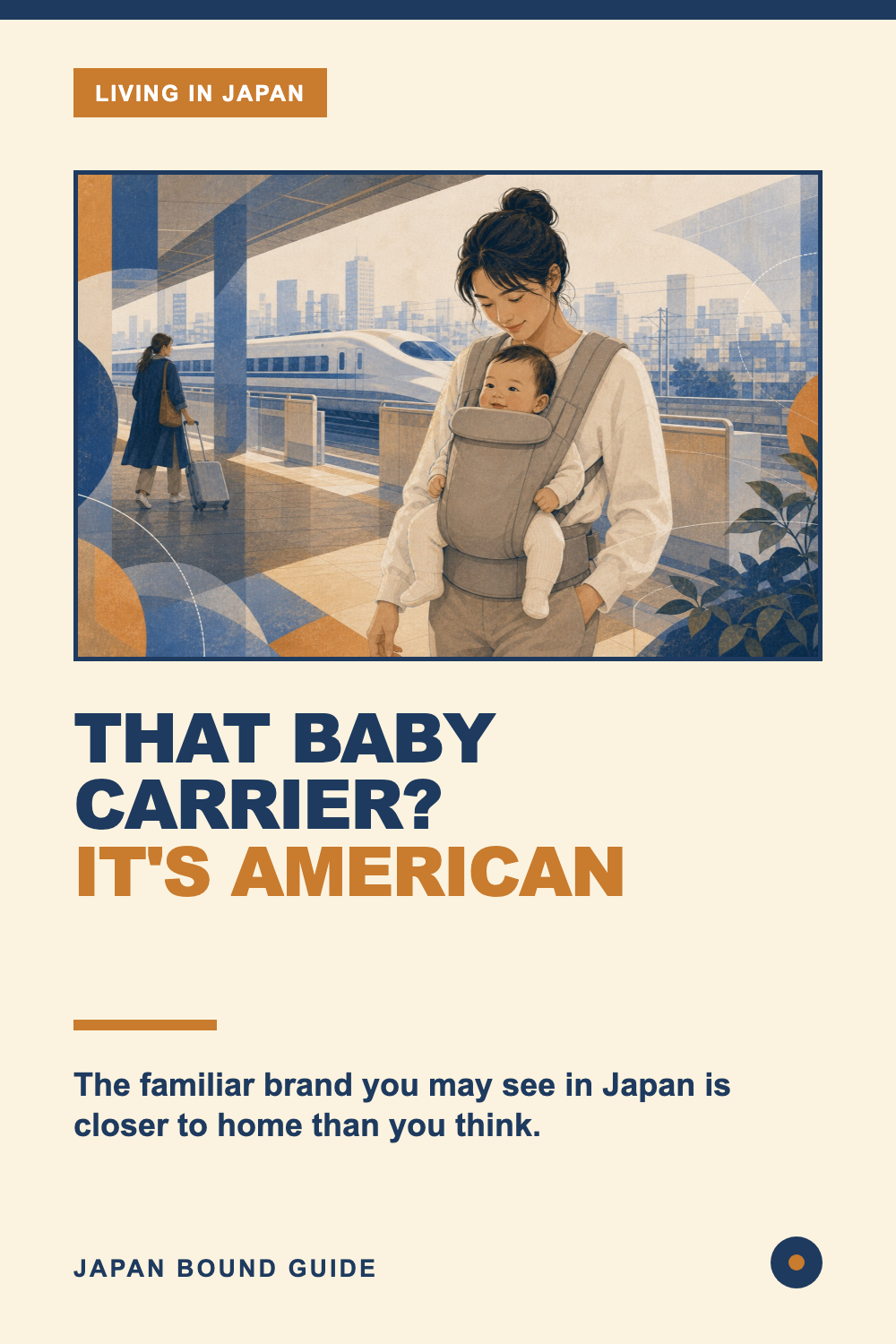
Spend an afternoon in any train station, park, or shopping street in Japan, and you’ll notice it: an enormous share of the babies being carried around are riding in the same style of soft structured carrier, usually in black or a muted neutral color, with a wide waistband and padded shoulder straps. If you look closely at the logo, there’s a decent chance it says Ergobaby — a brand so common here that many visitors assume it must be Japanese. It isn’t.
An American brand that happens to be everywhere in Japan
Ergobaby was started in 2003 by Karin Frost, who began by hand-sewing a carrier for her own child in Hawaii after struggling to find one that actually worked for how she wanted to carry her baby. The company grew from there into what’s now headquartered in Los Angeles, California, selling through more than 650 retailers and webshops in the US alone and in roughly 50 countries worldwide. In late 2024, it was acquired by Highlander Partners, a Dallas-based investment firm — so if anything, the brand’s ties to the US have only gotten more corporate, not less.
None of that history is visible if you’re just watching parents on a Tokyo platform. What you’ll see is a carrier that looks locally ubiquitous, because it functionally is — Ergobaby maintains an official Japanese retail site (ergobaby.jp) and is sold through a proper distribution network here, which is a large part of why it’s so easy to spot on any given day. But “popular in Japan” and “made in Japan” are two different things, and in this case only the first one is true.
Why this matters if you’re traveling with a baby
If you’re flying to Japan with an infant or toddler, this is useful in a very practical way: the carrier you keep noticing on other parents isn’t some exclusive product you need to track down and buy while you’re here. It’s the same brand you can walk into a store for — or order online — before you ever leave home. There’s no need to build “find the carrier all the local parents use” into your Japan packing list as some kind of scavenger hunt; you can sort it out in advance, the same way you’d buy any other piece of baby gear.
This cuts both ways, too. If you’re the one visiting family or friends who are raising a baby in Japan — say, an American grandparent flying out to meet a new grandchild — and you’re wondering what would actually be useful to bring, an Ergobaby carrier is a safe, well-tested choice that you can buy at home before you fly, rather than trying to guess at an unfamiliar Japanese brand or size things you can’t easily return.
A quick note on models
Ergobaby sells several different carrier lines, and the one you spot most often in Japan may not map neatly onto what’s marketed as the flagship model back home — retailers and popular styles can vary somewhat by country. If you already know which Ergobaby model you or someone you’re shopping for prefers, that’s the one to look for; if you’re starting from scratch, checking current best-sellers on Ergobaby’s own site before you travel is a more reliable way to land on the right one than trying to identify a specific style from across a train platform.
Quick FAQ
Is Ergobaby actually a Japanese company? No. It was founded in the US in 2003 and is headquartered in Los Angeles, California.
Why do so many parents in Japan seem to use it? Ergobaby has an established official retail presence in Japan (including a dedicated Japanese site), which has made it widely available and, from casual observation, a common sight among parents here. This is an observation, not an official market-share statistic.
Should I buy one before I fly to Japan, or wait and buy it here? Either works, since Ergobaby is sold both in the US and in Japan. Buying before you fly means you can start using it immediately upon arrival and skip figuring out sizing or model availability in a store that may not have English-language support.
Is this the only baby carrier brand worth knowing about? No — it’s simply the one you’re most likely to notice repeatedly during a trip, which made it worth explaining. This isn’t a full carrier buying guide or a comparison against other brands.
Conclusion
It’s a small thing, but it’s a good example of a broader pattern worth keeping in mind while traveling: not everything that looks distinctly “local” actually is. Ergobaby is about as American as a company gets — founded in Hawaii, headquartered in Los Angeles — and yet in Japan it reads as part of the everyday scenery of parenthood. If you’re packing for a trip with a baby, or shopping for one, that’s one less mystery to solve once you land.

コメント