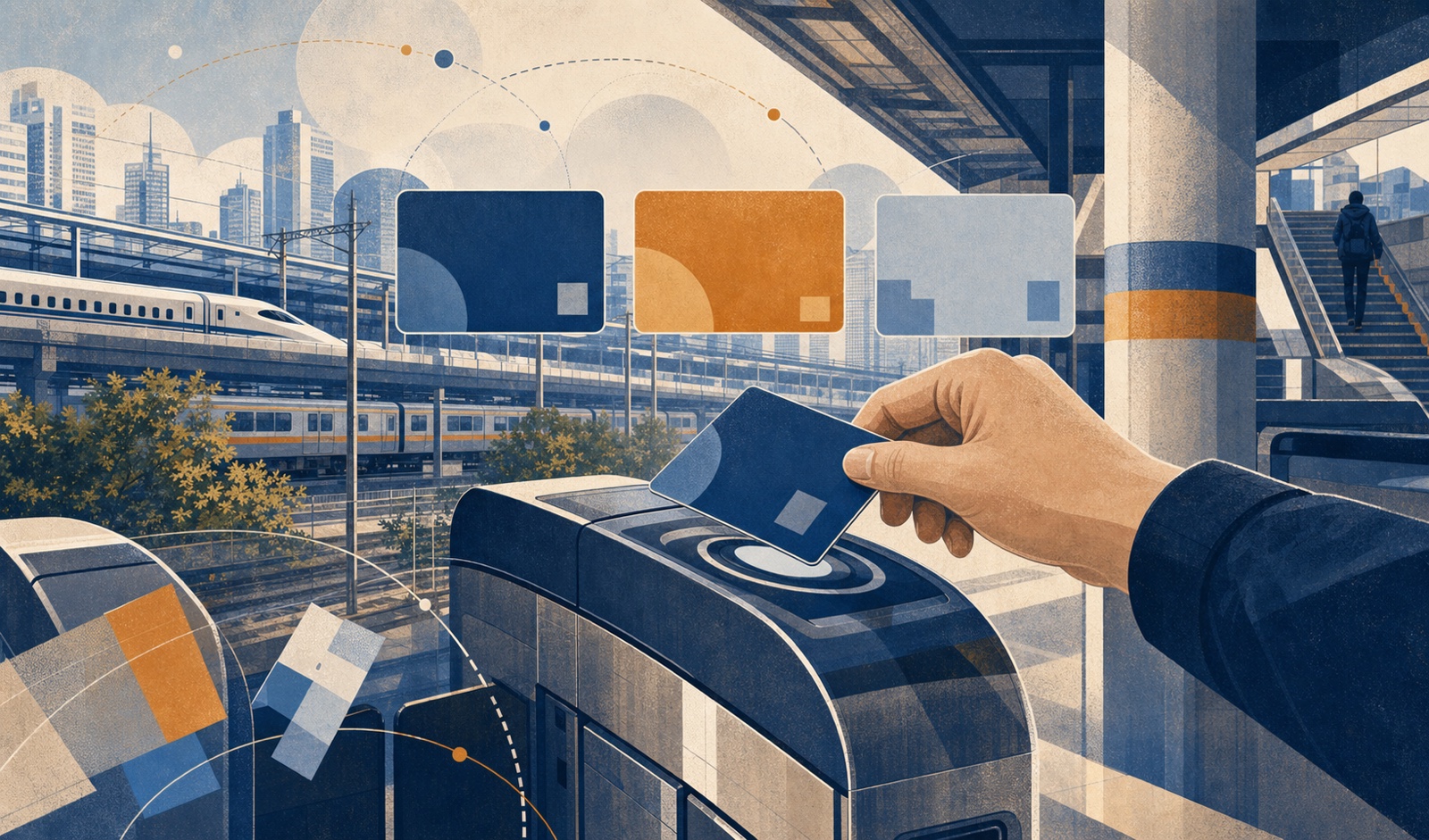
Suica, PASMO, or Welcome Suica: Which IC Card Should You Get for Japan?
Almost every guide to Japan tells you to get an IC card before you start using trains, and almost none of them explain that there are now several different versions built for different kinds of visitors. Getting the wrong one for your trip means either overpaying or running into a card that’s harder to reload than it should be. Here’s what each one actually is.
What these cards actually do
An IC card is a rechargeable prepaid card you tap on a reader at train and subway gates, on buses, and at the checkout in convenience stores, vending machines, and a lot of restaurants. You load money onto it, and fares or purchases get deducted automatically — no fumbling with ticket machines or exact change. Japan’s nine major regional transit IC cards — Kitaca, Suica, PASMO, Toica, manaca, ICOCA, SUGOCA, nimoca, and HAYAKAKEN — are mutually compatible for payment, so a card issued in Tokyo generally works on trains, buses, and at store registers in Osaka, Fukuoka, and most other major cities too.
There are four main ways to handle this as a visitor: Welcome Suica, TOURIST PASMO, a regular Suica card, or — increasingly — just tapping the contactless credit card you already have.
Welcome Suica (JR East)
Welcome Suica is JR East’s version built specifically for short-term visitors. It costs whatever amount you choose to load — ¥1,000, ¥2,000, ¥3,000, ¥4,000, ¥5,000, or ¥10,000 — with no separate deposit added on top. It’s valid for 28 days starting from the day you buy it (note: the “GOOD THRU” date printed on the card itself is not the actual expiration date — the 28-day clock starts on your purchase date regardless of what’s printed).
You can buy it at Narita Airport (Terminal 1 and Terminal 2·3 stations), Haneda Airport (Terminal 3 station), or at JR East Travel Service Centers in central Tokyo — including Tokyo, Shibuya, Shinjuku, Ikebukuro, Ueno, and Yokohama stations, plus Sendai. As a rule, you can only buy one per person. Topping up is cash-only, up to a ¥20,000 balance, at ticket machines or Seven Bank ATMs inside 7-Eleven stores — credit cards don’t work for reloading. Whatever balance is left when your 28 days are up is gone; there’s no refund, so try to spend it down or keep the card as a souvenir rather than overloading it near the end of your trip.
TOURIST PASMO
TOURIST PASMO is the equivalent product from the PASMO side, and the practical differences from Welcome Suica matter. It’s priced the same way (¥1,000 up to ¥10,000, no deposit) and also valid for 28 days from purchase — but it’s sold only at Haneda Airport (via Keikyu) and Narita Airport (via Keisei), not at any city-center stations. If you’re arriving through Haneda or Narita and want this one specifically, buy it on your way out of the airport, because you won’t find it downtown.
Reloading works differently too: station ticket machines take cash up to a ¥20,000 balance, but if you top up on a bus, drivers only accept ¥1,000 bills and won’t add funds if it would push your balance above ¥10,001. Some convenience stores can also reload it — ask staff. One more thing worth knowing: if you lose a TOURIST PASMO, it cannot be reissued, unlike some other transit cards. Like Welcome Suica, any leftover balance is non-refundable when the 28 days run out.
Regular Suica (or PASMO)
If your trip is longer than 28 days, or you’d rather have your unused balance back at the end instead of losing it, a standard Suica card is worth considering instead of the visitor-specific versions. It costs ¥1,000 to ¥10,000, but ¥500 of whatever you pay is held as a refundable deposit — when you return the card at a JR East station, you get that ¥500 back, along with your remaining balance minus a ¥220 handling fee (and importantly, you still get the full ¥500 deposit back even if your remaining balance is too low to cover that fee). Unlike the visitor cards, it has no expiration date built in. The tradeoff is that it’s designed as a general-use card, not a tourist product, so there’s no special visitor packaging or English-language purchase flow guaranteed at every machine.
Tap to Ride Service: skipping a card entirely
The newest option isn’t a card at all. Since March 25, 2026, eleven Kanto-area railway and subway operators — Tokyo Metro, Toei Subway, Odakyu, Odakyu Hakone, Keio, Keikyu, Sagami Railway, Seibu, Tokyu, Tobu, and Yokohama Minatomirai Railway — have jointly run a “Tap to Ride Service” that lets you touch a contactless credit, debit, or prepaid card (or a smartphone with one registered) directly on the ticket gate reader, no IC card needed. There’s no advance registration; you just tap in and tap out, and the fare is billed to your card afterward. Accepted card brands are Visa, Mastercard, JCB, American Express, Diners Club, Discover, and UnionPay.
A few restrictions matter: only the person whose name is on the card can use it (no lending it to a travel companion), there’s no child fare — anyone tapping in is charged the adult rate — and you need to use the exact same card to tap out that you used to tap in.
Here’s the important gap, and it’s a big one for anyone spending most of their trip on JR trains: JR East is not part of this network. The Yamanote Line, the Chuo Line, and most of the JR routes that get you around central Tokyo aren’t covered by Tap to Ride — you’d still need a Suica, PASMO, or one of the visitor cards above for those. This option is genuinely useful if your itinerary leans heavily on the private railways and subway lines in the list above, but it doesn’t replace an IC card for a typical JR-heavy Tokyo itinerary.
Quick comparison
| Card | Price | Deposit | Validity | Where to buy | Refund on unused balance |
|---|---|---|---|---|---|
| Welcome Suica | ¥1,000–¥10,000 | None | 28 days from purchase | Narita/Haneda airports + several central Tokyo stations | No |
| TOURIST PASMO | ¥1,000–¥10,000 | None | 28 days from purchase | Haneda and Narita airports only | No |
| Regular Suica | ¥1,000–¥10,000 (¥500 of it is deposit) | ¥500 (refundable) | No expiration | JR East stations generally | Yes, on return (minus a ¥220 handling fee; the ¥500 deposit itself is always refunded in full) |
| Tap to Ride (contactless credit card) | No card to buy — use your own | None | N/A | N/A — just tap at participating gates | N/A (postpaid, no balance) |
Which one should you actually get?
If your trip is under 4 weeks and you land at Narita or Haneda, either Welcome Suica or TOURIST PASMO works fine — pick whichever is more convenient to buy at your arrival point, since Welcome Suica is also available at some city stations if you don’t grab one at the airport, while TOURIST PASMO is airport-only.
If you’re staying longer than 28 days, or you’re the type who’d rather get money back than eat a leftover balance, get a regular Suica or PASMO instead — the ¥500 deposit comes back to you, and it doesn’t expire while you’re still using it.
If your trip is centered on the private railways and subway lines covered by Tap to Ride rather than JR, and you’d rather not buy a card at all, tapping your existing contactless credit card is a genuinely simpler option — just don’t rely on it as your only way to pay for transit, since it won’t get you through a JR gate.
Whichever one you choose, remember that reloading an IC card is cash-only at machines — keep some yen on hand rather than assuming you can top up with a card.
Conclusion
All of these do roughly the same basic job — tap to ride, tap to pay — so the real decision comes down to trip length, where you land, and how JR-dependent your itinerary is. Short trip through Narita or Haneda: Welcome Suica or TOURIST PASMO, whichever is easier to grab on arrival. Longer stay, or you want your money back at the end: a regular Suica. Sticking mostly to Tokyo Metro, Toei, or the private railways and don’t want another card in your wallet: your existing contactless credit card, as long as you know it won’t work on JR East.


コメント