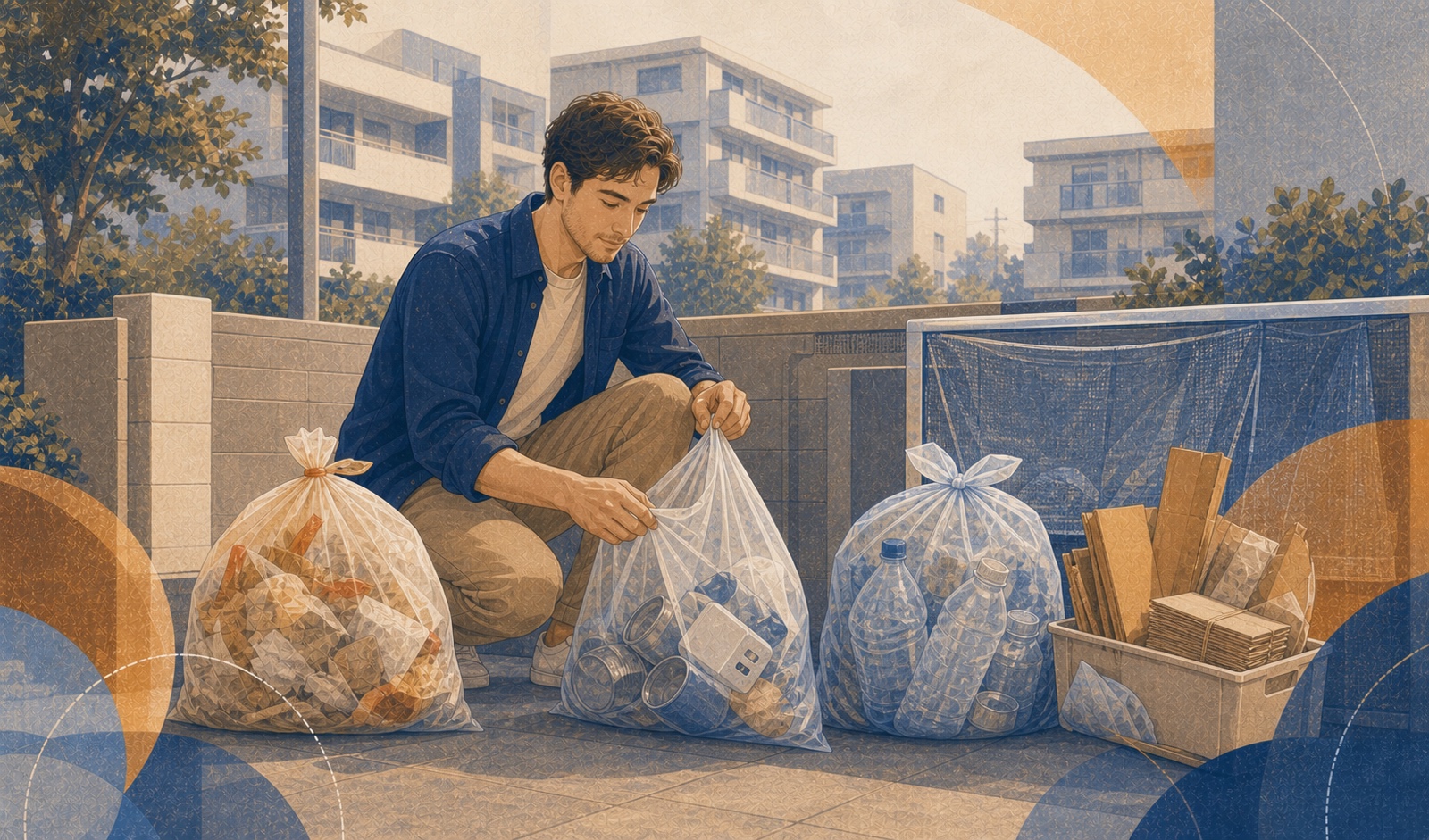
Ask any foreign resident in Japan what surprised them most about daily life here, and garbage disposal comes up constantly. It’s not that the system is irrational — it’s that there’s no single system. Japan doesn’t have one national set of rules; each municipality sets its own categories, collection days, and disposal procedures. Move across a ward boundary and the rules can genuinely change. This guide explains the framework that most municipalities share, then walks through two real examples — Tokyo’s Shibuya and Setagaya wards — so you can see both the common structure and where the details actually differ.
The categories almost every municipality uses
Despite the local variation, most Japanese municipalities sort household waste into some version of the following:
Combustible (burnable) garbage — kitchen scraps, food waste, paper scraps that can’t be recycled, small amounts of wood or yard trimmings, clothing and fabric, diapers, and most everyday plastic items that aren’t otherwise recyclable. This is usually the most frequently collected category, often twice a week.
Non-combustible (incombustible) garbage — metal items, glass, ceramics, small household appliances (typically anything under about 30cm on its longest side), and items like empty spray cans or lighters. This is collected far less often, typically once a month.
Recyclable resources — usually broken into sub-categories that get sorted separately: paper (newspapers, magazines, cardboard, bundled with string), glass bottles, aluminum and steel cans, and PET plastic bottles (cap and label removed, rinsed, and crushed). These are typically collected weekly.
Large-sized garbage — furniture, futons, bicycles, and anything else too big for a regular garbage bag. This almost always requires an advance reservation and a paid fee sticker purchased ahead of time; you can’t simply put a large item out with your regular trash.
Recycled home appliances — air conditioners, TVs, refrigerators/freezers, and washing machines or clothes dryers are handled completely separately from normal garbage collection in every municipality we checked. You’re expected to contact the retailer you bought it from, or a dedicated appliance recycling reception center, and pay a separate recycling fee. Do not put these out with your regular trash — most collection offices explicitly will not take them.
Two real examples, side by side
To see how much the details actually vary even within the same city, compare Tokyo’s Shibuya and Setagaya wards, using each ward’s own official English-language guide.
Shibuya publishes specific, ward-wide frequencies: combustible garbage twice a week, non-combustible once a month, and recyclables once a week, the same schedule for every household in the ward. Collection has to happen by 8:00 a.m. (7:30 a.m. in shopping and entertainment districts), and you’re allowed up to three 45-liter bags per collection for free — a fourth bag gets treated as business waste and requires a paid fee sticker.
Setagaya, one of Tokyo’s largest and most populous wards, doesn’t publish a single ward-wide schedule at all. Its official guide is literally printed with blank fields — “Every ___ and ___” — because collection days vary by specific neighborhood within the ward, and residents are expected to fill in their own local schedule from a separate collection calendar. Setagaya also has a rule Shibuya’s guide doesn’t mention: PET bottles (and non-combustible garbage) aren’t collected at all between the 29th and 31st of the month.
Neither ward is unusual here — they’re both entirely normal examples of how Japanese municipalities handle this. The point isn’t that one is right and one is wrong; it’s that you genuinely cannot assume your friend’s rules in a different ward (or even a different neighborhood in Setagaya’s case) apply to you.
Practical rules that show up almost everywhere
A few habits will keep you out of trouble regardless of which municipality you’re in:
- Use transparent or semi-transparent bags. Nearly every category — recyclables, non-combustible garbage, even some combustible waste — has to go out in bags where collection staff can see the contents. Opaque bags are frequently rejected outright.
- Rinse containers before disposal. Bottles, cans, and PET bottles all need to be rinsed clean of food or drink residue. Dirty containers can get your entire bag left uncollected.
- Respect the collection time. Garbage generally needs to be out by a specific morning hour (commonly 7:00–8:00 a.m.), not the night before. Putting bags out too early is one of the more common sources of friction with neighbors, since it can attract crows and other animals.
- Don’t guess — check your own address. Because the rules are set locally, the single most useful thing you can do as a new resident is find your specific ward or city’s official garbage calendar (often available in English on the municipal website, sometimes as a dedicated app) rather than relying on general advice, including this article.
Quick FAQ
Is there one national rulebook for sorting garbage in Japan? No. Each municipality — and in some cases, as with Setagaya, specific neighborhoods within a municipality — sets its own categories and schedule.
What happens if I sort my garbage wrong? At minimum, your bag will likely be left at the collection site uncollected, often with a sticker or note flagging the problem. Repeated mistakes can draw complaints from neighbors, since improperly sorted or early-set-out garbage is a common source of local friction.
Can I just throw away my old TV or air conditioner with the regular trash? No — in both Shibuya and Setagaya, air conditioners, TVs, refrigerators/freezers, and washing machines/dryers are excluded from normal collection entirely. You need to arrange separate paid recycling through the retailer or a dedicated reception center.
Are there English-language resources for this? Often, yes. Both Shibuya and Setagaya publish official English guides, and Setagaya specifically offers a dedicated sorting app. Availability varies by municipality, so check your own ward or city office’s website first.
Conclusion
The reputation Japan’s garbage rules have for being confusing is fair, but it’s confusing for a specific, explainable reason: there isn’t one system to learn, there are thousands. The categories — combustible, non-combustible, recyclables, large items, and separately recycled appliances — are common enough that once you understand the shape of the system, you’re most of the way there. What’s left is simply looking up your own address’s actual schedule, which your ward or city office almost certainly publishes.


コメント